Circuit breakers (CB) trip when detecting overcurrent conditions, specifically overloads and short circuits. This tripping characteristic varies with the magnitude of the current and the tripping time. This is precisely the criterion used to classify CB characteristic curves. Let Etinco help you understand the definition and the differences between these curve types.
What is a CB Characteristic Curve?
The CB characteristic curve, also known as the Trip curve or time-current characteristic curve, is a graph that illustrates the correlation between the tripping time (Y) and the current magnitude (X), showing the CB interruption behavior at various current values. Alternatively, the characteristic curve can be understood as the value indicating the speed of circuit interruption by the circuit breaker at a given current value.
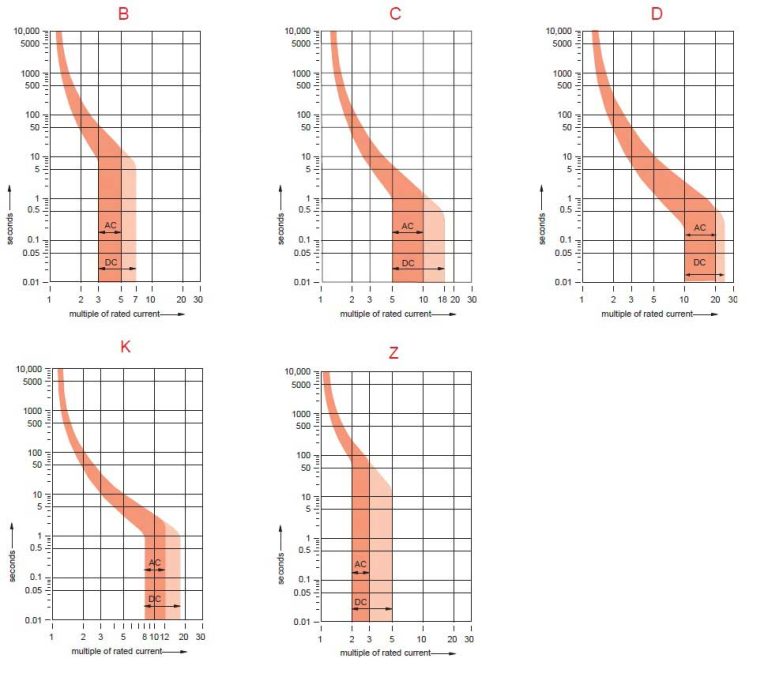
Characteristic curves are denoted by uppercase letters and are found on the catalog or the faceplate of the switching devices. The characteristic curve designation is associated with the rated current value. For example: K40 is understood to mean that this CB has a Type K characteristic curve and a rated current (In) of 40A.
To fulfill its basic function of protection against overload and short circuit, the CB must interrupt the circuit as quickly as possible when an overcurrent occurs. However, if the CB protects too rapidly, it can lead to issues. A typical example is the high inrush current that occurs when starting a motor, which can cause a line voltage drop. A CB tripping in this scenario would be disruptive.
Therefore, the CB needs to be able to withstand the starting current without causing a power outage and incorporate a certain time delay before interrupting the circuit. This is where the circuit breaker's tripping characteristic comes into play: it prevents immediate tripping during motor startup and avoids tripping too late, thus preventing electrical faults.
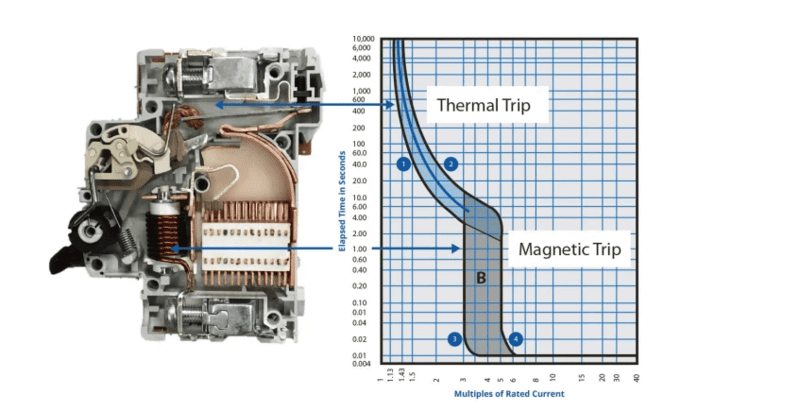
The operational range of the characteristic curve classifies CB into different types, where each type is used for a specific load.
How to Read the Characteristic Curve
A typical characteristic curve usually consists of 3 main components:
- Thermal trip: The curve for overload protection.
- Magnetic trip: The curve for short-circuit protection.
- Ideal trip curve: The manufacturer's ideal protection curve.
Taking the diagram illustrating the Type C characteristic curve of an MCB as an example, the X-axis represents the value I/In and the Y-axis represents the time (in seconds). Higher current corresponds to a shorter tripping time.

These two curves are nearly parallel and enclose the tripping region of the device. This region is divided into two smaller areas: the Thermal tripping region – determined by the bimetallic strip and responsible for overload protection; and the Electromagnetic tripping region – influenced by the solenoid and responsible for short-circuit protection.
According to the diagram:
- At an I/In = 2, the thermal overload trip will be activated after approximately 20 seconds.
- At an I/In = 20, the short-circuit trip will be activated after approximately 0.01 – 0.02 seconds.
Specific example: For a 30A load, a compatible MCB of 30A is selected.
- Under normal conditions, meaning the current is from (1-1.13) x 30A, the CB will not trip.
- When overloaded, meaning the load current increases to 1.5 x 30 = 45A, the earliest tripping time for the CB is 40s, and the latest is 100s.
- For the short-circuit protection region, a current of 3x-6x has the earliest trip time between 0.01s - 2.5s.
In practice, the correlation between current and tripping time can be affected by the ambient environment or the CB lifespan.
Classification of CB Characteristic Curves
There are 5 types of circuit breaker characteristic curves, denoted by the letters B, C, D, K, Z.
Type B Curve
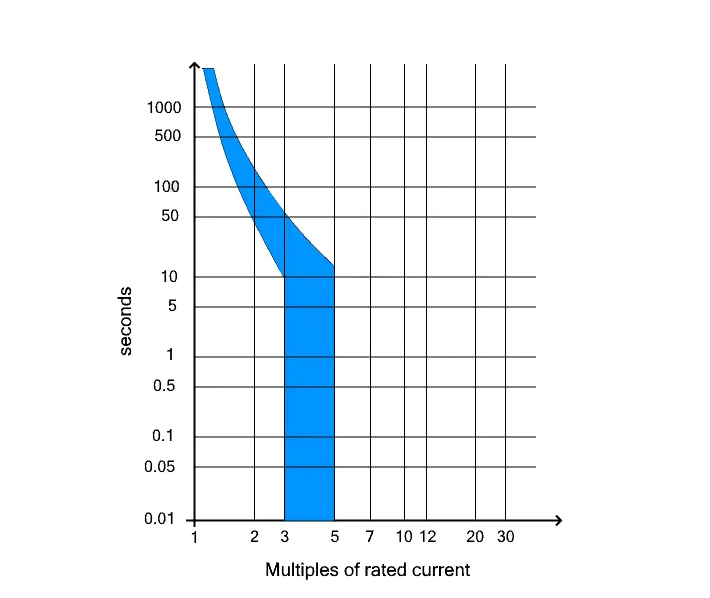
The B curve is designed for instantaneous tripping when the current reaches 3-5 times the rated current (In). The tripping time is approximately 0.04 – 13 seconds. This curve is suitable for applications with very low current surges and requiring fast interruption, such as resistive loads and lighting circuits.
Type C Curve
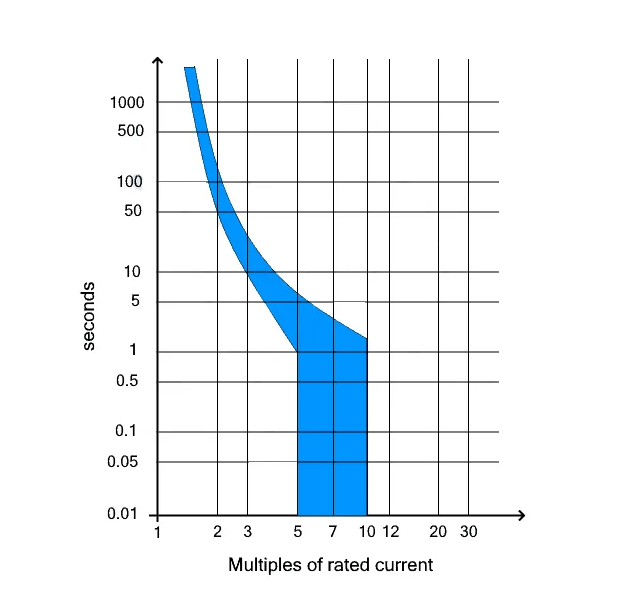
The C curve is used for circuit breakers capable of tripping when the current reaches 5 – 10 times the rated current (In), with a tripping time of 0.04 – 5 seconds. Due to its medium current surge threshold, the C curve CB is used to protect small-capacity motors and transformers.
Type D Curve
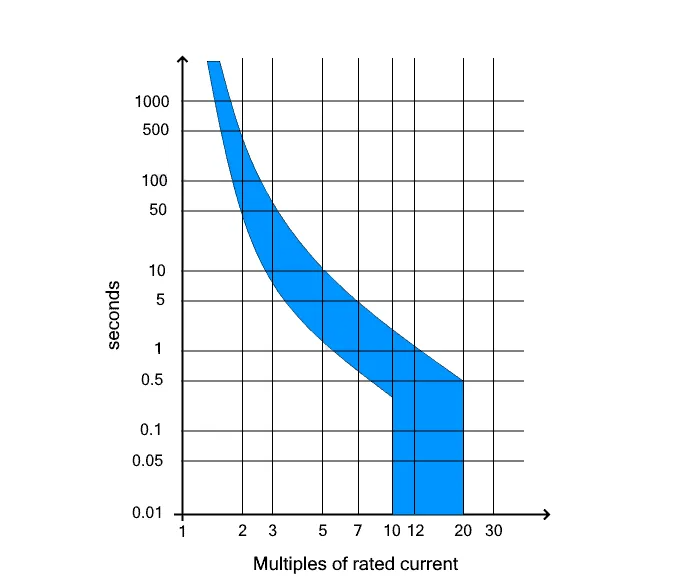
A CB with a Type D curve will trip instantaneously when the current reaches 10 – 20 times the rated current (In), with the standard level being 12.5 times. The tripping time for the D curve is within the range of 0.04 – 3 seconds. The CB using the D curve can withstand the large starting current of motors, making it suitable for running heavy loads in industrial applications.
Type K Curve
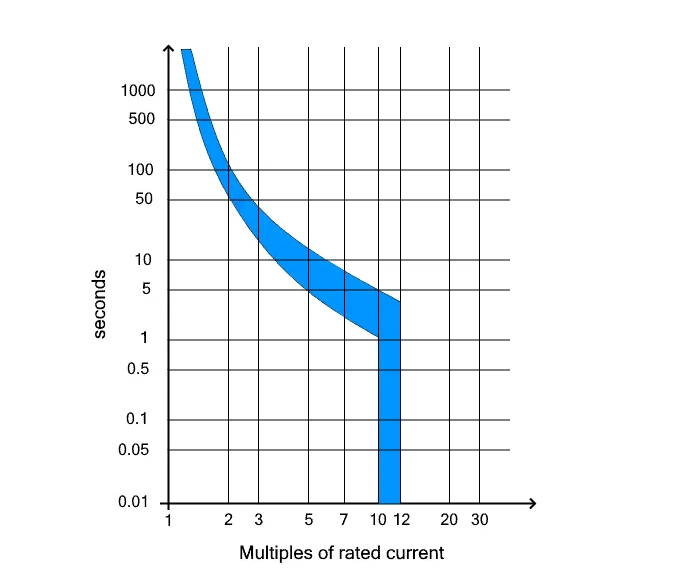
A circuit breaker with a Type K characteristic curve provides tripping capability when detecting a current of 10 – 14 times the rated current, with a tripping time of 0.04 - 5 seconds. This curve type is typically used to protect inductive loads and motor loads with high starting currents.
Type Z Curve
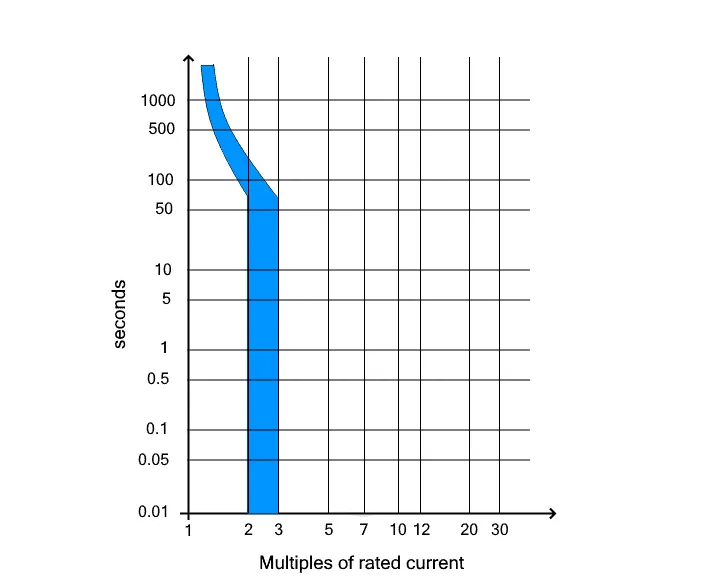
The Type Z characteristic curve is characterized by tripping at a threshold of 2 – 3 times In. CB with a Z curve are used in applications with extremely high sensitivity, requiring strict short-circuit protection, such as semiconductor devices.
Some Questions Regarding CB Characteristic Curves
Question 1: If the characteristic curve symbol is not present on the face of the CB, how can the trip curve be distinguished?
Answer: The most common CB characteristic curve value is Type C, so some types of circuit breakers may not have the symbol displayed on the faceplate.
Question 2: Which characteristic curve $\text{CB}$ should be used for medical applications?
Answer: The D curve is often used for high inductive loads and is thus applied to medical equipment such as X-ray machines.